ANWAR-UL ISLAM MOVEMENT OF NIGERIA
Alhaji Muhammed Lawal Basil Agusto, QC
First President of the Ahmadiyyah Movement-in-Islam in Nigeria · 1919–1920. Jurist, Islamic scholar and community leader.
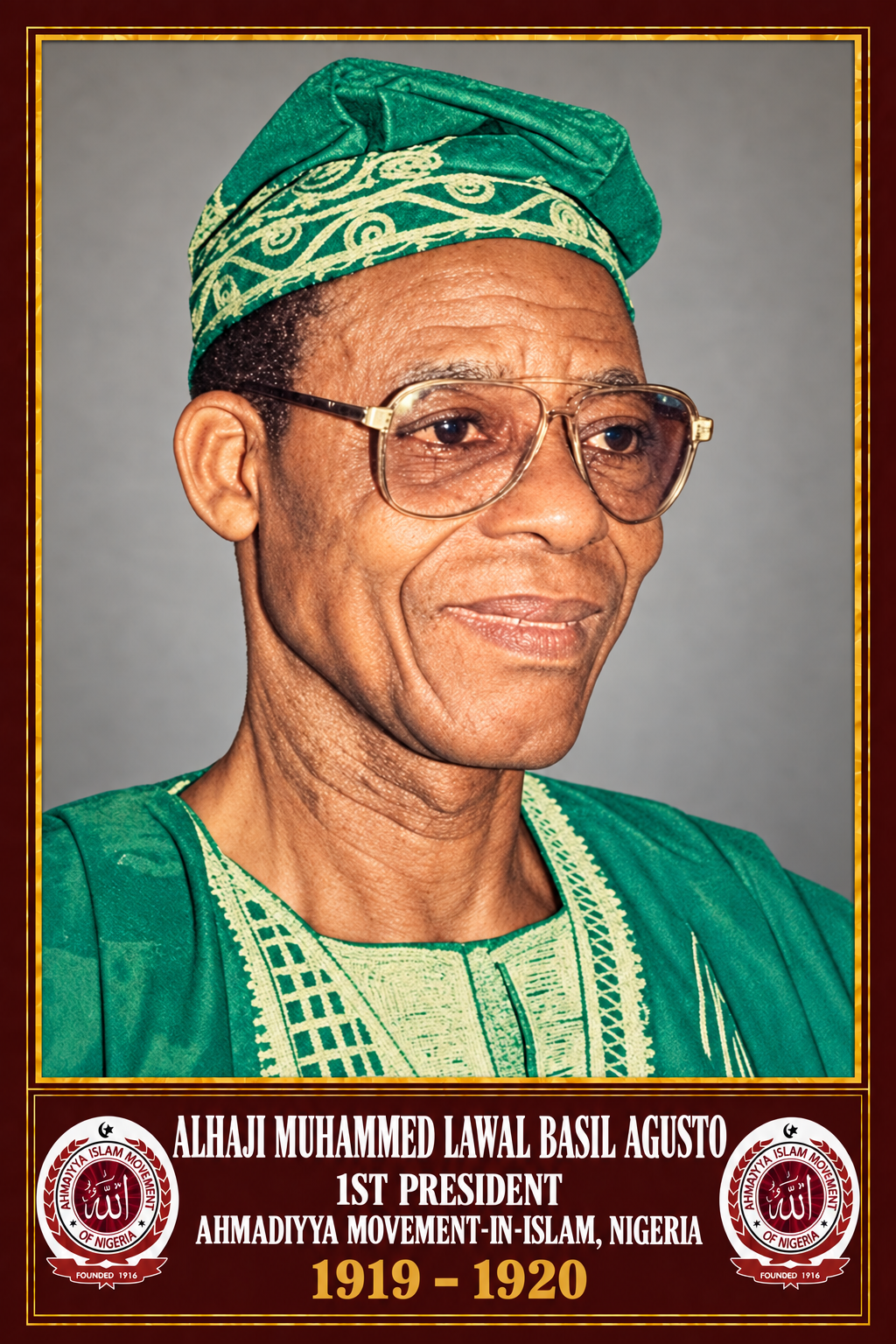
Date: 1919–1920
Office: 1st President
Term: past
# Alhaji Muhammed Lawal Basil Agusto, QC (1880–1971)
## A Distinguished Jurist, Islamic Scholar and Community Leader
### First President of the Ahmadiyyah Movement-in-Islam in Nigeria
Alhaji Muhammed Lawal Basil Agusto occupies a distinguished place in the history of Islam, legal practice and community leadership in Nigeria. A pharmacist who later became a lawyer, he combined professional achievement with profound religious conviction. As an Islamic scholar, educator and reformer, he devoted his life to the advancement of Muslims, the defence of their rights and the promotion of education. His career also reflected a capacity to maintain friendships and professional relationships across religious boundaries.
### Early Life and Family Heritage
Born in 1880, Agusto came from a prominent Muslim family of Brazilian ancestry in Lagos. His father was Senghor Abubakar Joao Agusto, popularly known as “Taiyese,” and his mother was Ajoke Aneedu.
The Agusto family settled in Bamgbose, within the Popo Aguda district of Lagos, between 1840 and 1847. They belonged to the Brazilian returnee community, whose cultural and religious traditions contributed significantly to the development of Lagos.
Although many members of that community were Catholics, it also included established Muslim families, among them the Agustos, Salvadors, Yahya Tokunbohs, Tiamiyus, Martins, Gomezes, Da Silvas and Pedros. Muslim members of the community established places of worship such as Olosun Mosque, Alagbayun Mosque on Taiwo Street, Tairu Eko Mosque and Salvador Mosque. Agusto therefore grew up in an environment shaped by both Islamic and Catholic traditions.
### Education and Early Career
At a time when many young Muslims faced barriers to admission into mission schools, Agusto received his secondary education at St. Gregory’s College. His admission was attributed to his academic ability and his father’s strong relationships within the Catholic community.
After completing his secondary education, he taught part-time at a Muslim secondary school, contributing to the educational advancement of young Muslims. His initial professional ambition, however, was to become a pharmacist.
He enrolled at the School of Pharmacy in Lagos, where Dr. Oguntola Sapara was among his teachers. Sapara reportedly took a particular interest in him, recognising his intellectual ability, strength of character and religious devotion. Agusto qualified as a pharmacist and established a successful career before turning to law.
### Early Islamic Leadership
Agusto’s commitment to Islam found an early expression in the Muslim Literary Society, a youth organisation dedicated to religious reform and the advancement of Muslims. He was a founding member, and his residence at 63 Bamgbose Street, Lagos, served as a meeting place.
Other founding members included B.A. Fanimokun, A.R.A. Smith, B.A. Disu, A.B.O. Agbabiaka and H.A. Subair. The society provided a forum in which educated Muslims could discuss their faith and consider how to respond to the social and intellectual challenges of their time.
Agusto subsequently played a central role in establishing the Ahmadiyyah Movement in Nigeria. Accounts of its origins associate his interest in the movement with his exposure, through Dr. Sapara, to the periodical *Islamic Review*.
The movement was formally established in 1916. Under its original constitution, Alfa Adam Idowu Yaqub served as Chairman and Agusto as Vice-Chairman. Other members of the founding executive included Jibril Martin, B.A. Fanimokun, who served as Financial Secretary, and Muhammed Jumat Selem. Alfa Kasumu Rufai Ajose was its first Imam.
Following a constitutional amendment, Agusto became the movement’s first President. He held the office until 1920, when he travelled to London to study law.
### A Pioneer in the Legal Profession
Agusto’s decision to pursue law reflected both his intellectual ambition and the standing of the profession in colonial society. Legal training offered opportunities for public service, advocacy and influence that complemented his existing work as a religious and community leader.
He completed his legal education in 1923, was called to the Bar in 1924 and returned to Nigeria that year. He is identified in the accounts underlying this biography as Nigeria’s first Muslim lawyer and its seventy-fourth legal practitioner.
His qualification marked an important milestone for the Muslim community. At a time when Muslims remained underrepresented in the professions, his achievement demonstrated that Western education and professional distinction could coexist with a steadfast commitment to Islam.
### Religious Conviction and the Islamic Society of Nigeria
Agusto’s years in London also prompted a reassessment of his association with the Ahmadiyyah Movement. He encountered differing interpretations of the religious status of its founder, Mirza Ghulam Ahmad, particularly concerning whether he was regarded as a reformer or as a prophet.
For Agusto, the finality of the prophethood of Muhammad was fundamental. His understanding of that principle ultimately led him to withdraw from the movement.
On returning to Nigeria in 1924, he explained his concerns to its members and urged them to reconsider their position. When most chose to remain, he left and established the Islamic Society of Nigeria.
A.K. Laguda later regarded this decision as evidence of Agusto’s integrity: a leader who could acknowledge a change in conviction and act upon it demonstrated both courage and strength of character.
The doctrinal questions that concerned Agusto continued to shape the movement’s subsequent history. In May 1974, three years after his death, the Ahmadiyyah Movement-in-Islam adopted the name Anwar-ul-Islam Movement of Nigeria.
Within the Islamic Society of Nigeria, Agusto worked with figures including Boonyamin Gbajabiamila, General Secretary, and Alfa M.K. Ekemode, Chief Missioner. A.K. Laguda later served as General Secretary. Other prominent members included M.O. Oseni, A. Fashola, I.A. Thanni, Y.A. Kekere-Ekun, Alfa R.A.B. Jose, A.T. Ariori, T.M. Asuni, A.T. Giwa, M.A. Iginla, T.A. Timson, Alhaji L.A. Finni and Dr. A.H.S. Tinubu.
### Scholar, Teacher and Mentor
As a leading figure and Chief Imam of the Islamic Society of Nigeria, Agusto became an inspiration to young Muslims, especially those pursuing higher education. He embodied a combination they valued: a professionally accomplished lawyer with a deep knowledge of Islamic theology and an unwavering commitment to religious practice.
Professor Saburi Biobaku’s recollections offer a vivid portrait of his influence. Biobaku described Agusto reading the Qur’an outside his home in Bamgbose Street and explaining its teachings to visitors. His command of Arabic and devotion to Islam made a lasting impression on those who gathered around him.
At the invitation of Muslim students at Yaba Higher College, Agusto delivered weekly lectures without remuneration. He welcomed questions, encouraged discussion and introduced students to *Islamic Review*, which he continued to receive from England.
Biobaku and his friend Olumbe Bassir also visited Agusto’s home and accompanied him to Friday prayers at Campos Square. Dressed in a tailored suit and fez, Agusto delivered sermons in English and led the congregation in prayer. Through these encounters, he helped young Muslims develop confidence in their faith while pursuing modern education.
### Religious Dialogue and Muslim Unity
Agusto participated in public theological debates with Christian leaders, including the Reverend Forster and Bishop Adelakun Howells. Subjects included the nature of God, the virgin birth, the status of Prophet Muhammad, polygamy and forms of worship. Accounts by G.O. Gbadamosi and J.F. Ade Ajayi describe open-air debates that continued for more than a year and stimulated wider religious discussion.
His firm defence of Islam did not prevent cordial relations with Christians. He represented the Catholic Mission in Lagos in legal matters and maintained a friendship with Archbishop Leo Taylor. These relationships illustrate his ability to combine religious conviction with mutual respect.
Agusto also sought greater cooperation among Muslim organisations across Nigeria. Working with A.K. Laguda, he promoted the establishment of an All-Nigeria Muslim Council through which Muslims could address common concerns and defend their collective interests.
He served as its provisional President, while Laguda served as provisional Secretary. Although the initiative encountered obstacles, it reflected his belief that unity was essential to the community’s progress.
### Education and Public Service
The educational advancement of Muslims remained one of Agusto’s central concerns. He founded and managed a Muslim secondary school, although it was unable to survive under the education regulations of the period. The congregation he led also contributed to the establishment of primary and secondary schools in Lagos.
His work complemented that of his fellow lawyer and Muslim leader, Jibril Martin, whose efforts likewise focused on expanding educational opportunities. Together, they helped strengthen the foundations of Muslim participation in modern education.
Agusto’s public service extended beyond religious affairs. Alongside Dr. T.A. Doherty, he led a Committee of Elders advocating the creation of Lagos State. In 1967, the committee intensified its campaign and called on the Federal Military Government to establish the state by decree.
### Family and Continuing Legacy
Agusto’s family continued his tradition of service to Islam and public life.
His eldest child, Alhaja Mujeebat Abeke Anifowoshe, was an active member of the congregation’s Women’s Wing. Her husband, Chief S.A.R. Anifowoshe, was a senator in Nigeria’s First Republic, a prominent member of the Action Group and the Asalu-Oba of Lagos. He later served as Vice-President of the Ahmadiyyah Movement of Nigeria.
His daughter Habeebat Adesiyan Akeju is credited in the family account with pioneering achievements in education, pharmacy and poultry husbandry. His eldest son, Barrister Basheer Adewale Agusto, was called to the Bar in 1948.
Another daughter, Kafayaat Bakare, was called to the Bar in 1953 and is identified in the account as the first Nigerian Muslim woman lawyer. Professor Taofeeqat Abibayo Odutola became a professor of medicine associated with Lagos University Teaching Hospital.
Alhaja M. Folashade Biobaku, wife of Professor Saburi Biobaku, was also a prominent leader within the congregation and served as the first Vice-Chairman of its pioneer Lagos Branch Executive Committee.
### Death and Historical Significance
Alhaji Muhammed Lawal Basil Agusto died on 26 July 1971. He left a legacy that embraced law, theology, education and civic leadership.
Professor A.B. Fafunwa remembered him as an exceptional figure in the Lagos Muslim community: a scholar of Islamic law and theology, a respected lawyer and a source of inspiration to Muslims across Nigeria. Of Brazilian ancestry, he was described as being versed in Portuguese, Yoruba and English, alongside the command of Arabic recalled by Biobaku.
Agusto demonstrated that professional accomplishment, modern education and religious devotion could reinforce one another. Respected even by those who differed from him, he helped give the Muslim community greater confidence, dignity and representation. His life remains a significant chapter in the history of Islam and public service in Lagos and Nigeria.